CREATE
Circular Economy in Bangladesh’s Apparel Industry
Exploring the circularity shift in global apparel value chains and opportunities for Bangladesh's apparel industry in collaboration with EU brands.
CREATE is a collaborative research project between researchers in Denmark, the UK, Bangladesh, and national and international policy organizations and Bangladesh garment exporters association, funded by DANIDA through the Danish Consultative Research Committee for Development and the Danish Fellowship Centre.
 Aalborg University (AAU), Denmark
(Lead)
 Ahsanullah University of Science and Technology
(Local Coordinator)
 University of Dhaka Institute of Business
Administration, DU
 Copenhagen Business School (CBS)
 Manchester Metropolitan University, UK
 Manchester Fashion Institute
 University of London,SOAS, UK
 Bangladesh Garments Manufacturers and
Exporters Association
 Global Fashion Agenda (GFA), Copenhagen
 Ethical Trading Initiative, UK
 Danish Fashion and Textile (DM&T)
 Reverse Resources (RR)
 Power of Imagination, Denmark

Research Committee
for Development Research Danish Fellowship Centre
About
Create Project
CREATE (Circular Economy in Bangladesh’s Garments Industry) is a research and capacity-building project funded by the Danish Ministry of Foreign Affairs, Denmark (DANIDA). This is the first multi-stakeholder research project on circular economy in the apparel industry led by Aalborg University Business School, Aalborg University (AAU), Denmark, in partnership with Copenhagen Business School, SOAS, University of London, Manchester Metropolitan University and Manchester Fashion Institute, Global Fashion Agenda Copenhagen, Power of Imagination, Danish Fashion and Textiles (DM&T), Ethical Trading Initiative UK, Reverse Resources (RR), Institute of Business Administration (DU), Bangladesh Garments Manufacturers and Exporters Association (BGMEA) and Ahsanullah University of Science and Technology (AUST). AUST is hosting this project in Bangladesh and is responsible for local coordination in collaboration with AAU. CREATE aims to examine the circularity shift in apparel GVCs by investigating the challenges and opportunities it presents. It, however, aims to explore how Bangladesh’s apparel industry can implement circularity to retain its position in reconfigured apparel GVCs as well as drive green industrialization processes to meet the sustainability goals- 2030. The five-year long research project compromises five work packages that focus on mapping the pre-consumed textile recycling opportunities and challenges, baseline study of resource use and waste, firm-level capabilities and costs, and evaluation of the recycling initiatives/resources and corporate strategies leading to policy formulation and strategy development for suppliers and brands.
News
Updates
Recent
Events
Recent
Publications
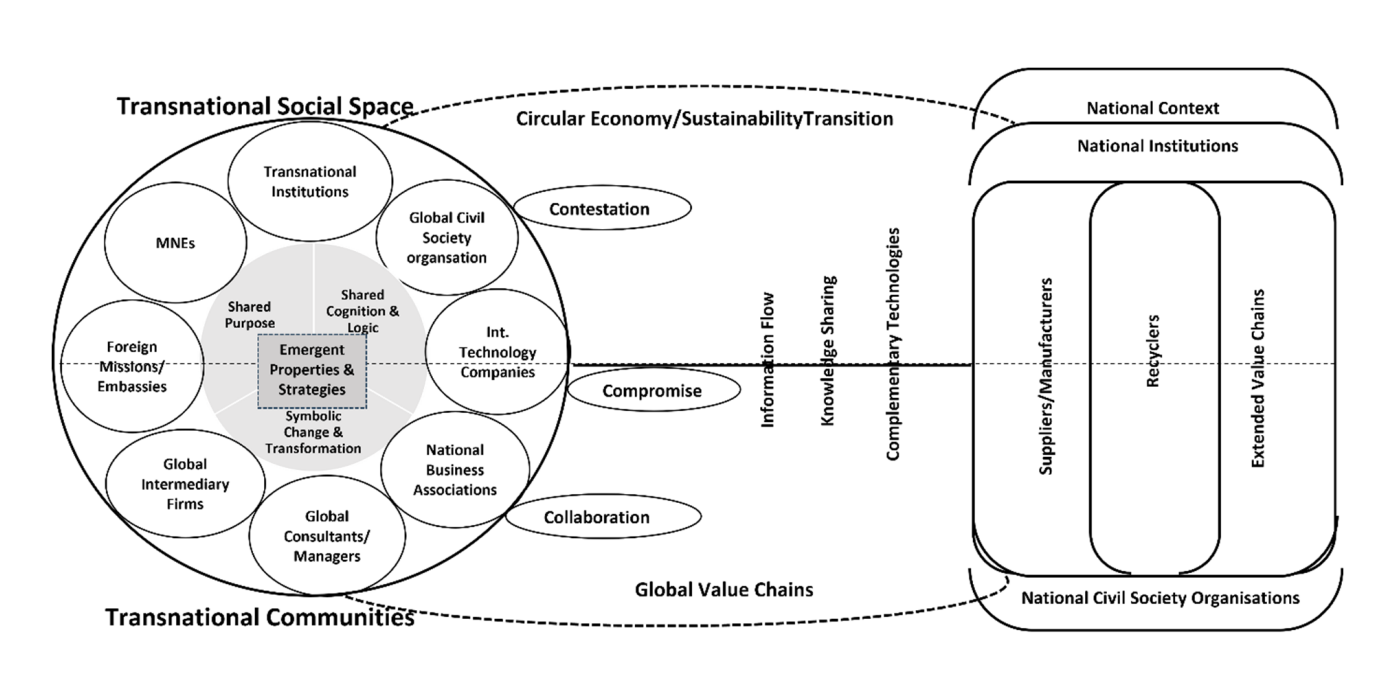
Global Value Chains and Transnational Social Spaces and Communities: The Emergence of a Circular Economy in the Apparel Industry
Authors: Mohammad B. Rana; Matthew M. C. Allen; Syed Ahmed Tajuddin
Challenges in apparel’s circular economy transition in Bangladesh
Authors: Rana, Mohammad B.; Whitfield, Lindsay